Human Factors in Wayfinding
Why do we get lost? Explore the human psychology of wayfinding, from cognitive maps and stress to inclusive architecture and practical design insights.
Introduction
Why we get lost, how our brains find their way, and what buildings can learn from the science of human navigation.
-
Smart Summary
- Finding your way is an act of thinking. We constantly interpret information, make spatial decisions, and check our progress.
- Our brains construct internal maps. These help us understand relationships between places, remember routes, and find alternatives.
- Stress changes how we navigate. When we feel uncertain or rushed, we may rely more on familiar routes and less on flexible exploration.
- There is no average navigator. Our abilities and experiences differ, and we use different senses to understand the same environment.
- Architecture is part of the information system. Landmarks, sightlines, layouts, signs, and digital guidance all influence how easily we find our way.
Finding Your Way Is More Complicated Than It Looks
The automatic doors slide open.
Elena enters a large hospital. Sunlight falls through the glass roof, people cross the entrance hall, and a dozen signs point toward departments she has never heard of.
She has an appointment in the West Wing, on the third floor.
Simple enough.
Except there are two elevator banks, several branching corridors, and no obvious indication of where the West Wing begins.
She looks at her appointment, scans the signs, and stops.
For a few seconds, she isn't moving. But inside her mind, an extraordinary amount is happening.
She's searching for recognizable information, remembering instructions, estimating directions, and deciding what to do next.
Nothing is wrong with her ability to walk. She simply doesn't yet understand the space.
And that distinction is at the heart of human wayfinding.
For decades, researchers in psychology, neuroscience, architecture, and environmental design have investigated how people navigate unfamiliar environments. Their discoveries reveal that finding our way is not simply about following signs. It is a continuous interaction between the human mind and the world around it.
So what does science tell us about this everyday experience?
1. Finding Your Way Is an Act of Thinking
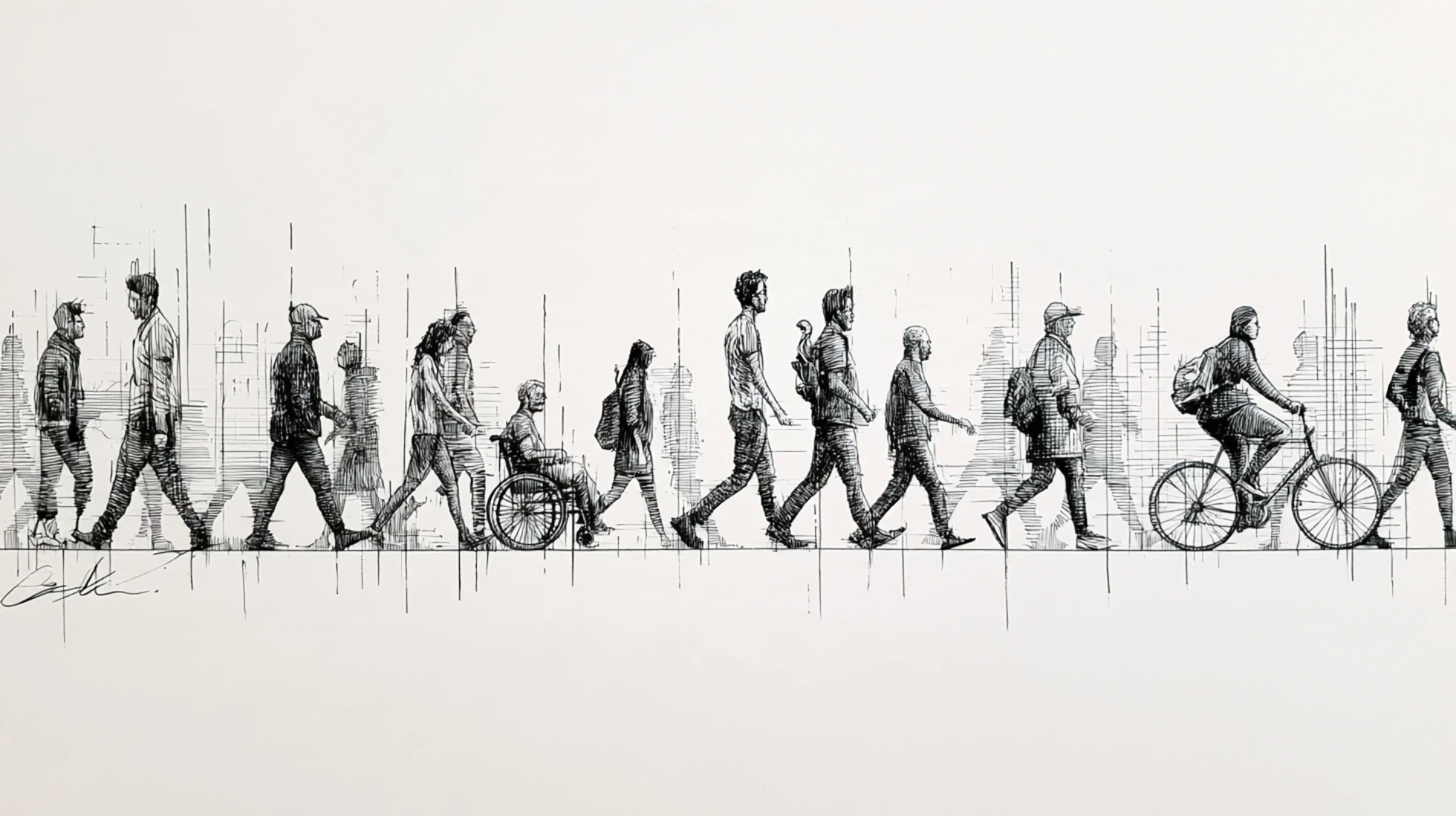
Walking and wayfinding might look like the same activity, but they involve different challenges.
Walking requires us to move, maintain balance, and avoid obstacles. Much of that happens with little conscious effort.
Wayfinding requires something more: knowing where we want to go and working out how to get there.
In the 1980s, researcher Romedi Passini helped establish wayfinding as a process of spatial problem-solving. Rather than simply following a route, people gather information, make decisions, act on those decisions, and evaluate the results.
Consider a familiar instruction:
Take the elevator to the third floor and turn left.
It sounds straightforward, but several questions are hidden inside it. Which elevator? How will you recognize the correct floor? Which direction is left when you step out? And how will you know whether you're still heading the right way?
Each movement creates another moment of interpretation.
This helps explain why we often hesitate at intersections. A corridor might be perfectly easy to walk through, but choosing between three unfamiliar corridors requires information we may not have.
It also explains why landmarks are so useful.
Compare these instructions:
| Direction | What your mind must do |
|---|---|
| "Walk 40 metres and turn left." | Estimate distance and identify the correct turning point. |
| "Turn left at the glass elevators." | Recognize a visible feature and connect it to an action. |
The second instruction gives us something concrete to look for.
Landmarks help connect our intentions to actual places. They can be a staircase, a large window, a distinctive wall, or a reception desk.
The design insight: Place useful information where decisions are made, and connect directions to recognizable features of the environment.
Good wayfinding doesn't simply tell us where to go. It helps us understand where we are.
2. The Remarkable Map Inside Your Head
Imagine walking through a neighborhood for the first time.
You pass a bakery, turn right at a park, cross a small square, and eventually reach a café.
Later, someone asks you where the bakery is.
You might remember the exact route. Or you might have a broader understanding of the neighborhood and realize there's a shortcut you never actually walked.
How is that possible?
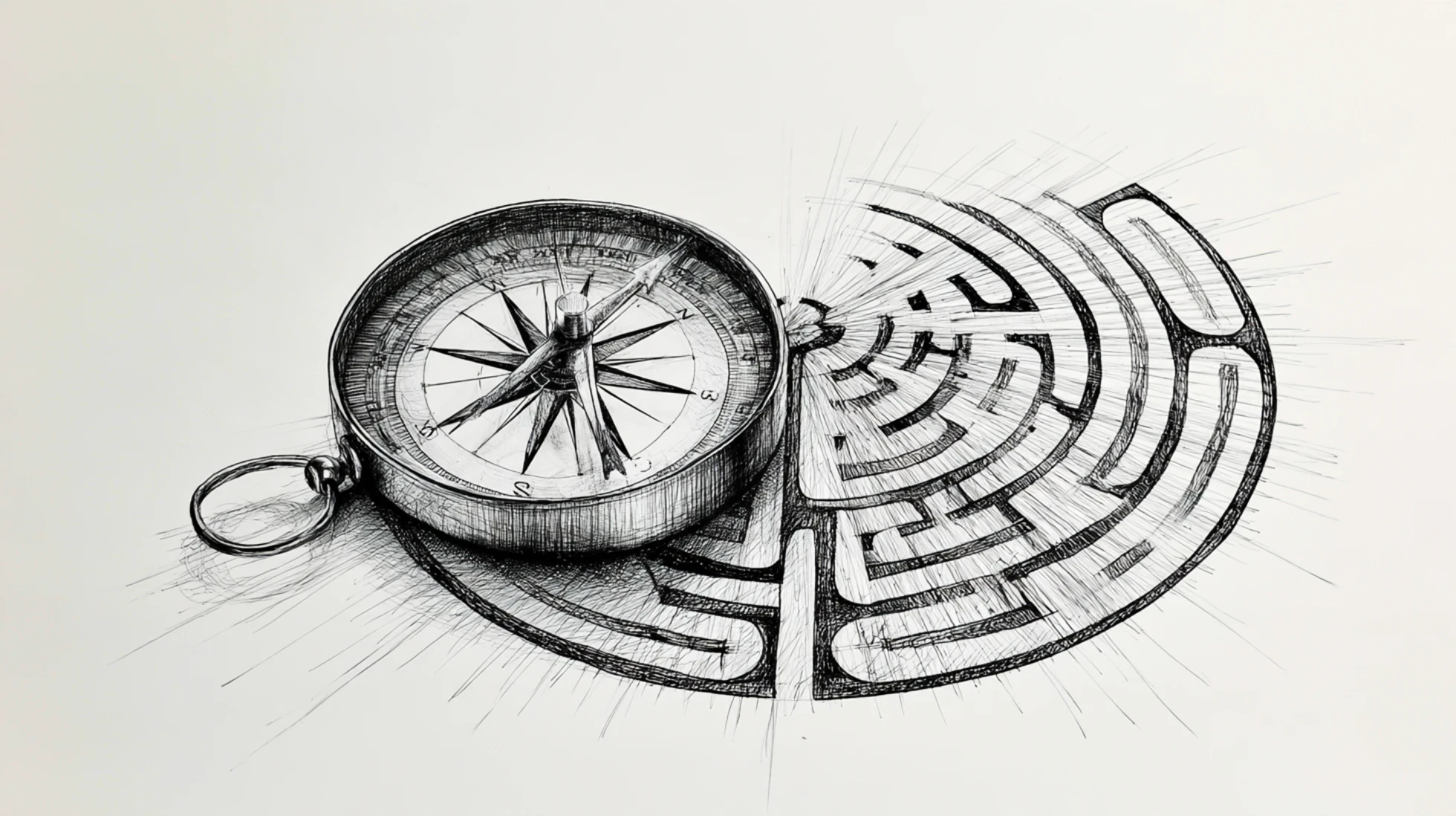
The answer lies partly in what scientists call a cognitive map: an internal representation of the spatial relationships between places.
The idea has fascinated researchers for decades. But some of the most remarkable discoveries came from neuroscience.
In 1971, John O'Keefe and Jonathan Dostrovsky recorded the activity of individual neurons in rats exploring an environment. They discovered that certain cells became active when an animal occupied a particular place.
These became known as place cells.
Decades later, researchers working with Edvard and May-Britt Moser discovered grid cells, whose activity forms repeating spatial patterns as an animal moves through its surroundings.
Together with other navigation-related neural systems, these discoveries helped reveal how the brain represents location, direction, and movement. Subsequent research found evidence of related spatial coding in humans. [1]
It is tempting to call this the brain's GPS. But there's an important difference.
A GPS calculates coordinates. Our cognitive maps are shaped by experience, recognizable places, memory, and the meaning we attach to them.
And not everyone develops these maps in the same way.
The Experiment That Challenged How We Learn Space
In 2006, researchers Toru Ishikawa and Daniel Montello conducted an intriguing experiment.
They took 24 college students through unfamiliar residential streets over ten weekly sessions. After each journey, the participants estimated directions and distances and demonstrated what they had learned about the environment.
One might expect everyone to begin with a vague understanding and gradually construct a more accurate mental map.
That wasn't what happened.
Some participants demonstrated relatively accurate spatial knowledge after their very first exposure. Others continued to struggle even after repeated visits. A third group improved gradually. [2]
The findings challenged the idea that everybody develops spatial knowledge through the same fixed sequence.
This helps explain a familiar situation: two people leave the same building, and one immediately understands how to return to the entrance while the other remembers only a series of turns.
The design insight: Never assume that visitors have developed a mental map. Support both people who understand the overall layout and those who depend on recognizable, sequential directions.
We don't all carry the same map of the world inside our heads—even when we're standing in exactly the same place.
3. Why Everything Gets Harder When We're Stressed
Back at the hospital, Elena has found the correct elevator.
She reaches the third floor, turns toward the West Wing, and encounters a temporary barrier.
The corridor is closed for maintenance.
Her appointment starts in five minutes.
Suddenly, the familiar instruction to follow the corridor is useless. She needs an alternative.
And now there's pressure.
Something similar happened in an experiment published in Scientific Reports in 2024.
Researchers led by Apurv Varshney asked 48 participants to navigate a virtual maze using immersive VR. After learning a route, participants encountered stressful conditions including blocked paths, fog, threatening sounds, and a countdown timer.
The researchers made an interesting discovery.
Even on stressful trials where shortcuts remained available, participants were less likely to use them. They tended to follow longer, previously learned routes instead.
The effect was particularly noticeable among participants who had developed a good understanding of the maze and therefore had shortcuts available to them in the first place. [3]
Stress appeared to change not just how efficiently people navigated, but how they approached the task.
This doesn't mean that stress automatically switches off our ability to think. The experiment was conducted in virtual reality, and several stressors were introduced together.
But it illustrates something important: finding our way depends on more than knowledge of the environment. Our emotional state matters too.
A visitor who is late for an appointment, worried about a medical diagnosis, or anxious about missing a train may experience the same building very differently from someone exploring it at leisure.
The information around us hasn't necessarily changed.
Our capacity to interpret it may have.
The design insight: Make route changes easy to understand. Confirm directions after unexpected turns, provide clear alternatives when routes are closed, and avoid asking people to solve complex spatial problems under pressure.
A building that's easy to navigate when you're relaxed may feel completely different when you're anxious, distracted, or in a hurry.
4. There Is No Average Navigator
Think of three people entering the same railway station.
One quickly understands its layout. Another follows every directional sign. A third relies on sound, tactile information, and remembered spatial relationships.
All three are navigating the same environment.
But they're not experiencing the same information.
Research has shown considerable differences in people's spatial abilities, how they acquire environmental knowledge, and which information they find useful.
Some differences relate to age and experience. Others involve perception, familiarity, culture, or the availability of sensory information.
One of the largest experiments exploring human navigation was Sea Hero Quest, a mobile game developed to collect spatial navigation data.
More than two million people participated. In a major 2018 analysis, researchers examined a large international sample and found that navigation performance varied with age, nationality, and other population-level factors. [4]
The findings remind us that navigation ability is not a single, universal human characteristic.
Navigating Without Sight
An especially important perspective comes from research into how blind and partially sighted people understand space.
In a 2026 study, researchers interviewed 56 people with different forms of visual impairment about navigating hospital environments.
They found that participants used combinations of tactile information, auditory cues, residual vision, and existing spatial knowledge.
People with different visual histories often described different ways of building an understanding of their surroundings. But these patterns were not rigid categories: individual experience and environmental conditions also mattered. [5]
A corridor can therefore communicate through more than its appearance.
Its boundaries, floor textures, acoustics, and recognizable transitions may all contribute to orientation.
A large glass atrium might provide excellent visual connections for one visitor, while offering fewer useful tactile references for another.
This leads to a fundamental principle of inclusive wayfinding.
The design insight: Information should not depend on a single sense or ability. Combine clear visual information with appropriate tactile, auditory, and spatial cues, and ensure that different forms of guidance remain consistent.
| Human factor | What can make navigation harder? | What can help? |
|---|---|---|
| Unfamiliarity | No existing knowledge of the layout | Recognizable landmarks and regular confirmation |
| Limited attention | Competing visual information | Clear hierarchy and well-placed directions |
| Stress or time pressure | Uncertainty and unexpected decisions | Simple choices and visible alternatives |
| Visual impairment | Inaccessible visual-only information | Multisensory cues and accessible route information |
| Differences in spatial ability | Difficulty forming an overall mental map | Sequential guidance supported by spatial context |
The point isn't to design a separate building for every type of navigator.
It's to create environments that offer more than one way to understand them.
5. Buildings Shape the Way We Think
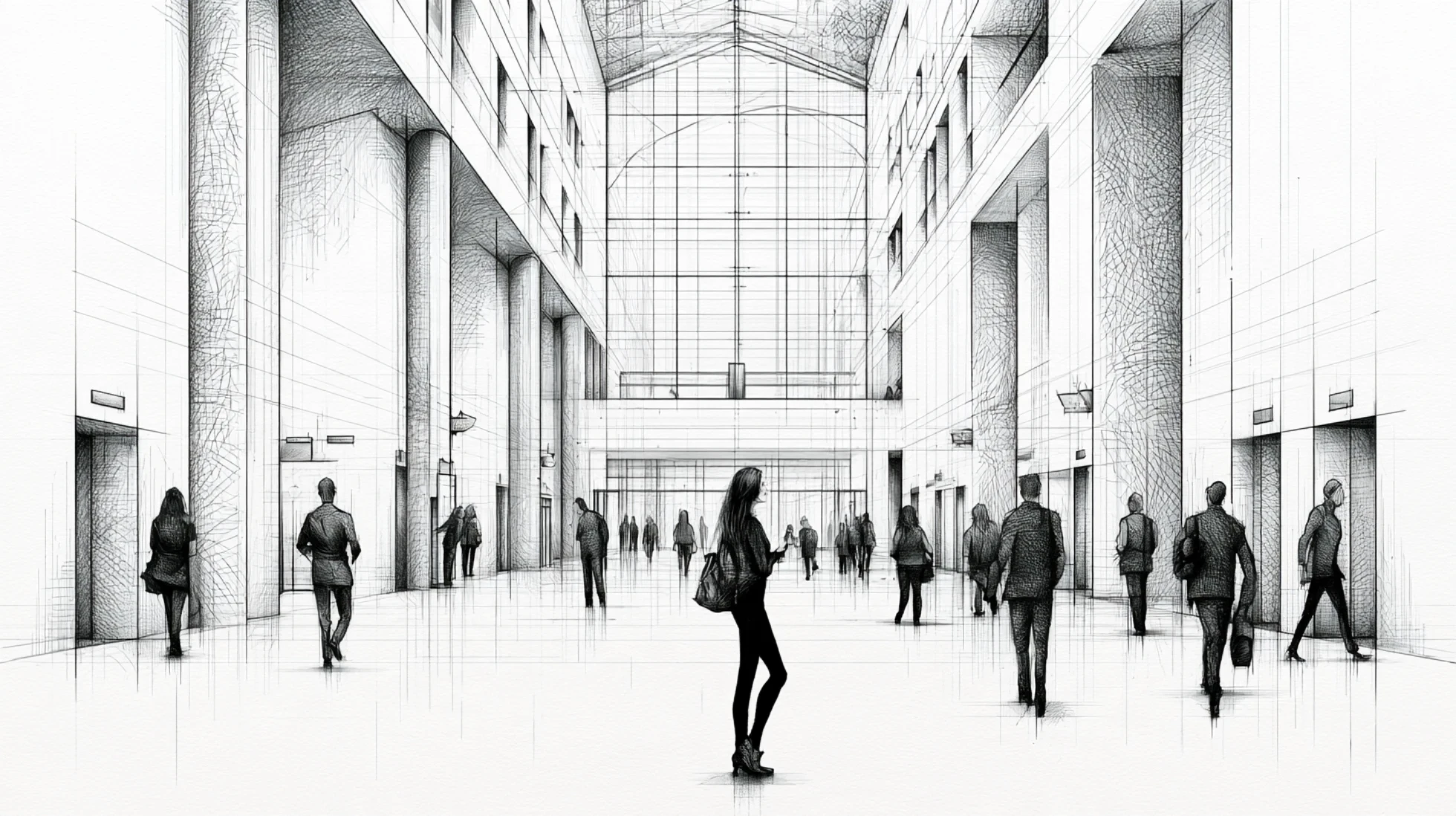
Why is it easy to remember the route through an old town, yet so difficult to find your way through a perfectly symmetrical office building?
Part of the answer may lie in the way environments organize information.
In his influential 1960 book The Image of the City, urban planner Kevin Lynch explored how people form mental images of cities.
He identified five elements that help people recognize and organize their surroundings: paths, edges, districts, nodes, and landmarks.
Consider an unfamiliar city with a river running through it.
The river provides a boundary and a reference. A distinctive tower helps identify the center. A public square becomes a memorable meeting point. Together, these features make the city easier to understand.
Buildings can offer similar clues.
An open staircase, a central courtyard, distinctive departmental areas, or a long view toward an entrance can all help people maintain orientation.
But what happens when the architecture provides few recognizable differences?
Can Signs Fix a Confusing Building?
In 1991, researcher Michael O'Neill investigated how building layouts and signage influence wayfinding.
The findings revealed an important relationship.
Signs improved navigation. But increasing floor-plan complexity still made finding one's way more difficult.
In the most complicated settings, having signage did not necessarily produce better wayfinding performance than navigating simpler settings without it. [6]
That's an important lesson.
Signs can help people interpret a building, but they cannot completely compensate for an environment that's difficult to understand.
More recent research has revealed another fascinating connection between people and places.
In 2022, Antoine Coutrot and colleagues analyzed navigation-game performance from nearly 400,000 people across 38 countries. Participants tended to perform better in virtual environments whose street patterns resembled those of places where they grew up.
People raised around irregular street networks, for example, showed an advantage on similarly complex virtual layouts. [7]
The results suggest that our experience of environments may help shape the spatial skills we develop, although the study cannot establish every underlying cause.
The design insight: Think of architecture as a source of orientation information. Distinguish important areas, preserve useful sightlines, and make the spatial organization understandable before adding layers of signage.
A building is already communicating directions long before anyone installs the first sign.
6. Designing for the Human Mind
Let's return to Elena.
Imagine the same hospital entrance, but with a few important differences.
The main elevator bank is visible from the entrance. Major departments are grouped into recognizable zones. A clear sign identifies the West Wing without listing every department in the building.
At the elevator, a map shows the layout in the direction Elena is facing.
When she reaches the third floor, another sign confirms she's still on the correct route.
And when a corridor is temporarily closed, an alternative is explained before she encounters the barrier.
None of these interventions is particularly spectacular.
Together, however, they make the environment easier to interpret.
Research offers several useful principles for designing spaces around human perception and cognition.
Six Principles Worth Remembering
| Principle | Practical implication |
|---|---|
| 1. Make spaces recognizable | Use meaningful landmarks, distinct areas, and clear spatial relationships. |
| 2. Support decisions where they happen | Place directional information at relevant choice points. |
| 3. Reveal information progressively | Present the next useful decision without overwhelming people with every destination. |
| 4. Align maps with the environment | Where practical, orient location maps to match the viewer's facing direction. |
| 5. Design for different abilities | Combine accessible visual, tactile, auditory, and spatial information. |
| 6. Confirm progress | Reassure people that they're still on the correct route, especially after turns or interruptions. |
These are design principles, not universal formulas. They need to be interpreted in relation to the building, its users, and the available evidence.
Map alignment, for instance, has been investigated experimentally. In 1984, Marvin Levine and colleagues examined how the placement and orientation of You-Are-Here maps affected their usefulness, demonstrating that the relationship between a map and its surroundings matters. [8]
Similarly, research on building complexity helps explain why clear signage alone cannot solve every spatial problem.
And studies of visually impaired navigators highlight the importance of not relying exclusively on visual communication.
What about digital navigation?
Smartphones can be remarkably helpful, particularly when navigating unfamiliar environments. Yet they introduce an interesting question: if a device always tells us when to turn, how much of the environment do we remember?
Research by Louisa Dahmani and Véronique Bohbot found an association between greater habitual GPS use and poorer spatial memory during independent navigation. Their longitudinal follow-up was small, so this should not be interpreted as proof that navigation apps permanently damage spatial ability. [9]
Still, it raises an intriguing design opportunity.
Perhaps the best digital wayfinding doesn't simply provide the next arrow. Perhaps it also helps people understand the world through which they're moving.
The same principle applies to physical signs, architectural landmarks, maps, and future spatial technologies.
All of them should help people make sense of space.
A Different Way of Thinking About Wayfinding
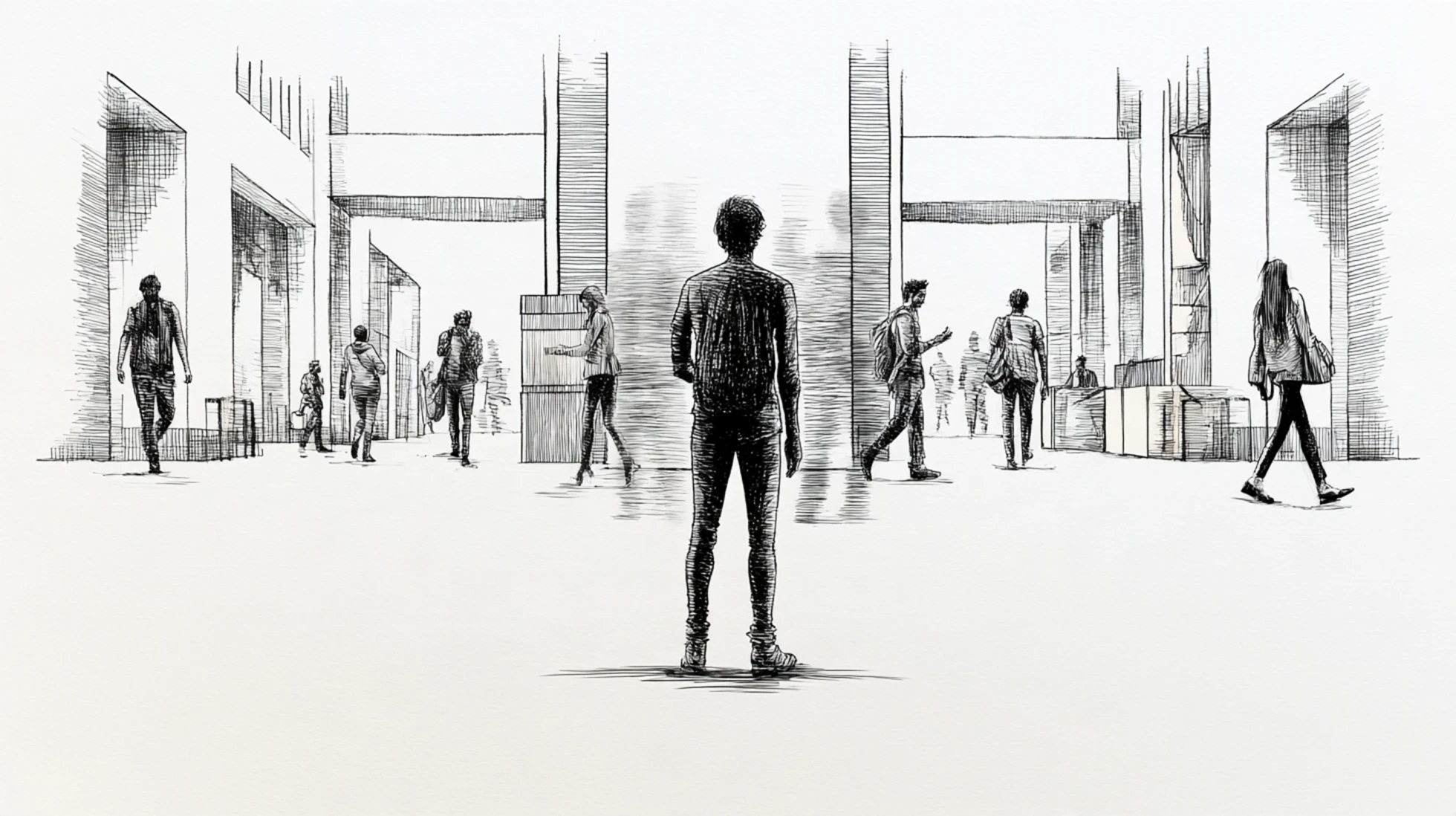
Elena eventually reaches her appointment.
She may not remember every sign she followed. She may not know the complete layout of the hospital.
But she remembers the courtyard near the elevators, the turn toward the West Wing, and the information that reassured her along the way.
The building gradually became understandable.
That's what makes human wayfinding so fascinating.
Our brains are continuously interpreting a world that was not necessarily designed around the way we perceive, remember, and make decisions.
We have remarkable spatial abilities, but those abilities are not unlimited. They differ between people, change with experience, and depend on the information an environment makes available.
For architects, designers, and anyone shaping public spaces, the lesson is simple:
The goal of wayfinding is not merely to direct movement. It is to create understanding.
And sometimes the most successful wayfinding design is the one people never consciously notice.
Frequently asked questions (FAQ)
-
What is the difference between walking and wayfinding?
Walking is the physical act of moving through a space. Wayfinding is the cognitive task of choosing a route, interpreting information, and checking that you are moving toward your destination.
-
Why do people get lost in buildings with directional signs?
Signs can help, but unfamiliar layouts, repeated corridors, poor visibility, stress, and information overload can still make the building difficult to understand.
-
What is a cognitive map?
A cognitive map is an internal representation of how places relate to one another. Some people form such spatial knowledge quickly, while others rely more on sequential directions and landmarks.
-
How can designers improve wayfinding?
Make spaces recognizable, provide guidance at decision points, align orientation maps with the viewer when practical, confirm progress, and support different sensory and cognitive abilities.
References & Further Reading
The following selection provides the scientific foundation for the article.
- Epstein, R. A., Patai, E. Z., Julian, J. B., & Spiers, H. J. (2017). The cognitive map in humans: Spatial navigation and beyond. Nature Neuroscience. DOI.
- Ishikawa, T., & Montello, D. R. (2006). Spatial knowledge acquisition from direct experience in the environment. Cognitive Psychology. DOI.
- Varshney, A., et al. (2024). Stress affects navigation strategies in immersive virtual reality. Scientific Reports. DOI.
- Coutrot, A., et al. (2018). Global determinants of navigation ability. Current Biology. DOI.
- Wu, Y., Du, X., Liu, F., & Kang, J. (2026). Spatial cognition in hospital buildings for different types of visual impairment: A framework based on Grounded Theory. The Journal of Architecture. DOI.
- O'Neill, M. J. (1991). Effects of signage and floor plan configuration on wayfinding accuracy. Environment and Behavior. DOI.
- Coutrot, A., et al. (2022). Entropy of city street networks linked to future spatial navigation ability. Nature. DOI.
- Levine, M., Marchon, I., & Hanley, G. (1984). The placement and misplacement of You-Are-Here maps. Environment and Behavior. DOI.
- Dahmani, L., & Bohbot, V. D. (2020). Habitual use of GPS negatively impacts spatial memory during self-guided navigation. Scientific Reports. DOI.
Additional foundational work: Kevin Lynch, The Image of the City (1960); Romedi Passini, Wayfinding in Architecture (1984); Montello and Hegarty, Human Factors of Wayfinding in Navigation.
Editorial note: Elena is a fictional character used to illustrate everyday wayfinding experiences. The scientific experiments are real. The practical recommendations are interpretations of the research, not universal architectural standards.

